For more than twenty years, I have carried a 2.05 GPA.
That’s an odd sentence for a forty-one-year-old woman to write.
Especially one who just finished her first semester back in college with a 4.0.
But transcripts have long memories.
They don’t care how much time has passed. They don’t know who you were when you earned the grades printed neatly across their pages. They don’t record circumstances or context. They simply keep the score.
And mine kept a score I wasn’t particularly proud of.
Twenty-something years ago, I went to college and failed miserably.
That’s the short version, anyway.
The longer version begins before college.
I dropped out during my senior year of high school and left Arkansas for Texas while I was still a minor. By eighteen, I was living a life that looked very different from the one most teenagers around me were living.
Somehow, in the middle of that chaos, I figured out a way to get into an alternative school program in Kilgore, Texas, and finish my high school diploma.
I did it.
I didn’t get to participate in graduation.
Eventually, college entered the picture. I was working full-time, moving between states, trying to navigate online classes in the early 2000s, and living inside an abusive marriage that consumed far more of me than any transcript could ever show.
I couldn’t keep up.
So I failed.
And the transcript recorded that part perfectly.
What it couldn’t record was everything happening outside the classroom.
There isn’t a column on a transcript for survival.
There isn’t a place to explain instability, fear, control, or chaos. There isn’t a footnote that says, This student was carrying more than coursework.
There are just grades.
Mine followed me for more than two decades.
This summer, at forty-one years old and as a mother of four, I went back to college.
The circumstances could hardly be more different.
This time, I wanted to be there.
I poured myself into twelve credit hours and finished my first semester back with a 4.0.
That 4.0 didn’t erase the old grades. It couldn’t.
But it moved the number.
2.05 became 2.78.
And for the first time, I started to see that old transcript differently.
A few months ago, I applied for the Arkansas Academic Challenge Scholarship. I knew my old GPA might be a problem, but I applied anyway.
The answer came back exactly as expected.
I wasn’t eligible.
I read the email, accepted the answer, and decided I would work hard, repair the damage, and try again next year.
So when I finished the summer with a 4.0, I emailed to ask what I needed to do to apply for the following school year.
Their answer surprised me.
If I could get my cumulative GPA above 2.5, I could potentially become eligible now.
Suddenly, no didn’t mean never.
It meant the circumstances that produced the no needed to change.
And they had.
This week, I received another email.
My summer hours had been added. My GPA was above 2.5. I was eligible for the scholarship.
That alone would have been enough to celebrate.
But then came the part I wasn’t expecting.
The Arkansas Academic Challenge Scholarship is tiered according to where you are in your college education.
In my mind, I was starting over.
I had returned to college after more than twenty years away. I had just completed what felt like my first semester.
Surely, I was a freshman.
Except I wasn’t.
Because apparently transcripts don’t just have long memories for the parts we’d rather forget.
They remember the credits, too.
The same old transcript whose grades had initially kept me from qualifying also contained enough earned credit hours to classify me as a sophomore.
And that changed the scholarship.
Instead of the freshman amount I had expected, I learned I would receive $5,000 for the academic year.
I just stared at it.
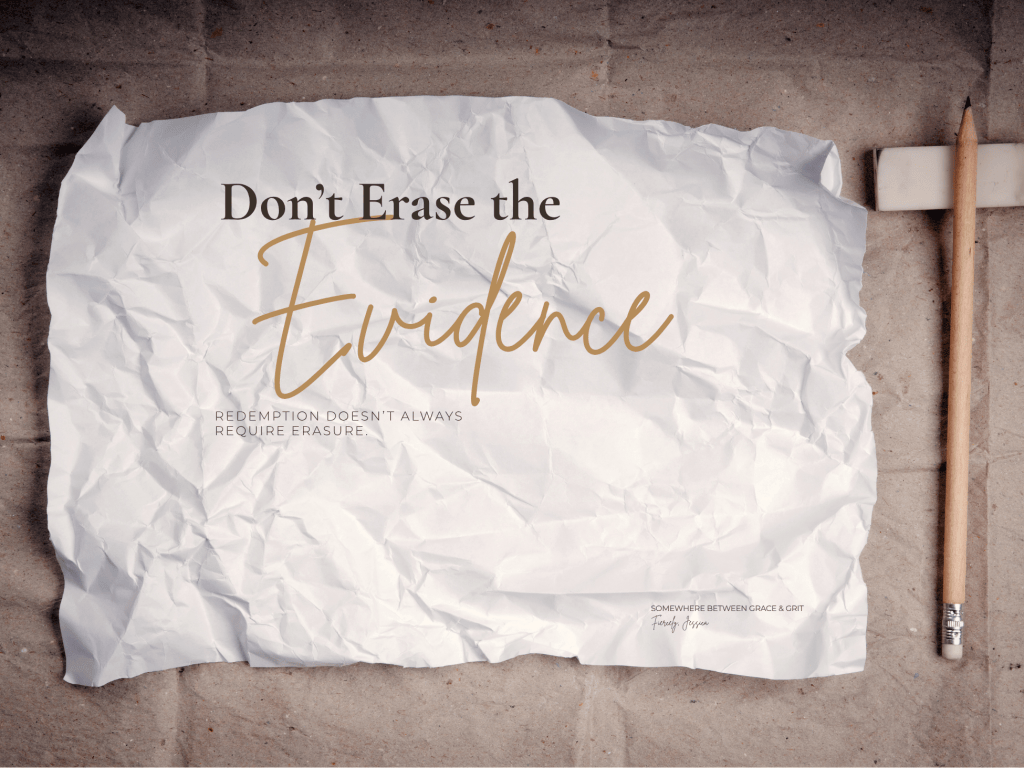
Because for years, if someone had handed me an eraser and offered to wipe those early college years off my record, I would have taken it without hesitation.
The failed classes.
The 2.05.
The embarrassment of starting something I couldn’t finish.
Erase it.
Let me start clean.
Except now, for the first time, I am grateful I couldn’t.
I’ve been thinking a lot about what redemption actually looks like.
I think sometimes we imagine redemption as erasure.
We want God to remove the ugly parts. Fix the record. Take away the evidence of who we were, what happened to us, what we chose, what we survived, or where we failed.
We want a clean page.
But God doesn’t always give us one.
Sometimes He does something far more interesting.
He writes the next chapter on the same page.
Scripture is full of people whose histories weren’t erased when God began using them.
Peter still denied Jesus.
Paul still persecuted Christians.
Rahab’s story didn’t begin with the respectable résumé we might have written for her.
Their pasts weren’t rewritten to make their futures more palatable.
God simply refused to let the past have the final word.
Maybe that’s part of what redemption is.
Not pretending something didn’t happen.
Not calling failure success.
Not romanticizing painful seasons or claiming every terrible thing happened because God needed it for some future purpose.
Just recognizing that what happened before does not get exclusive authority over what happens next.
My old transcript is still accurate.
I failed those classes.
That 2.05 belonged to me.
But it was never the whole story.
And maybe that’s what I’m finally learning to extend to the nineteen-year-old girl who earned it.
I don’t have to erase her.
I don’t have to be embarrassed by her.
And I don’t have to pretend she handled everything perfectly in order to have compassion for what she was trying to survive.
She finished high school when finishing high school wasn’t easy.
She worked.
She tried college.
She failed.
And then life kept moving.
Twenty-two years later, she came back.
There is something almost poetic to me about the fact that the very transcript I once wished I could erase is now helping carry me forward.
The grades didn’t change.
The credits didn’t change.
The history didn’t change.
I did.
And because I did, the same record reads differently now.
What once looked only like evidence of failure also contains evidence that I tried.
Evidence that I earned something even in the middle of chaos.
Credits that still count.
Progress that wasn’t erased simply because the ending wasn’t what I wanted it to be.
Maybe there are parts of our lives we’re too quick to label wasted because they didn’t produce the ending we expected.
Maybe some seasons aren’t meant to be deleted from the story.
Maybe they just haven’t finished telling us what they meant yet.
For more than twenty years, my transcript remembered a version of me I would have preferred to forget.
Today, I’m glad it did.
Fiercely,
Jessica


Leave a comment