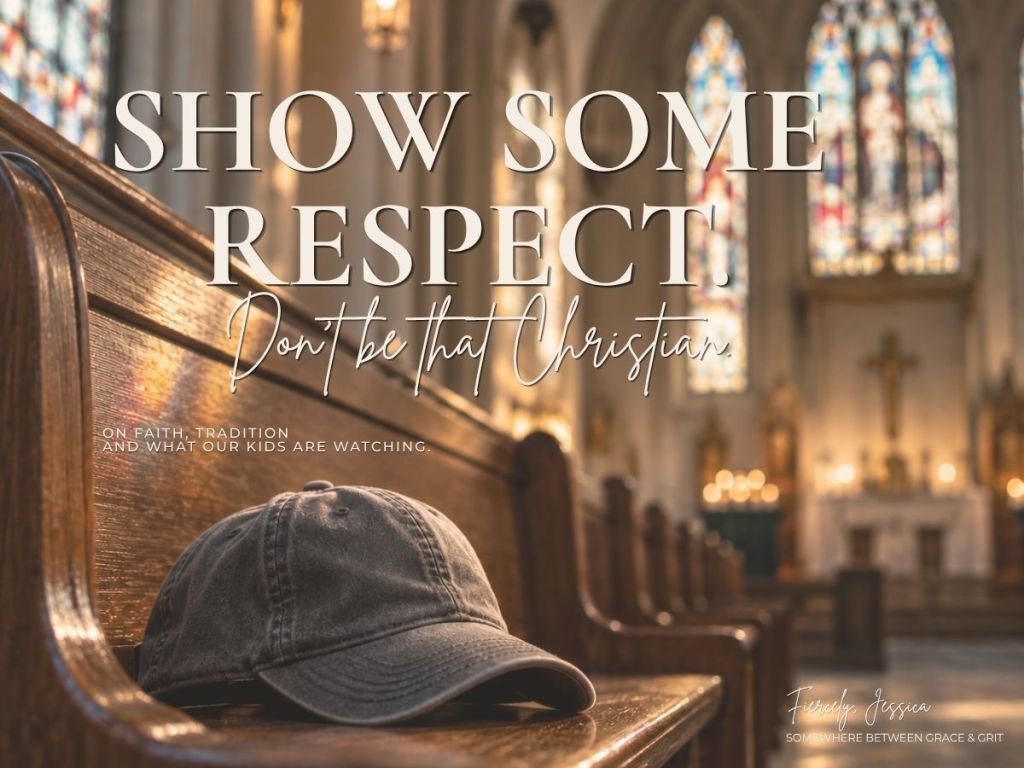
“Don’t be that Christian.”
New York City has a way of making you take things in.
Maybe it’s because there’s simply too much to see. Too many people. Too many stories happening at the same time. Too much history crammed between buildings that somehow still have room for hot dog carts and people yelling at taxis.
But one of the moments from our trip that I can’t stop thinking about happened somewhere I probably would have least expected it.
Inside a church.
We had just finished the 9/11 Memorial Museum. I wasn’t sure how Carter would handle it. He’s eleven, and there are some things you almost wish you could protect your children from understanding for just a little longer.
But he took it all in. He read. He listened. He asked questions. He didn’t rush through the hard parts.
To him, September 11 is history.
To me, it isn’t.
From there, we walked into St. Paul’s Chapel.
St. Paul’s is small, especially by New York standards, but it is mighty. It’s beautiful, quiet, and full of history. After everything we had just seen at the museum, its connection to September 11 made walking through those doors feel significant.
We were tourists, but I understood that while this was sightseeing for us, it was still a sacred space to other people.
Security was our first stop, which became a production mostly because my brother Christopher apparently travels prepared for every possible fashion emergency.
Hat. Watch. Belt. Phone. More things.
He kept peeling off layers for the metal detector while I joked with one of the security guards about how ridiculously extra he is. She laughed. We laughed. It was lighthearted and welcoming.
Carter and I finished first, gathered our things, and put our hats back on while we were still near security. Nobody said anything about them.
Christopher was still reconstructing himself, so Carter and I started slowly walking through the chapel.
There were only a handful of other people inside. Carter and I slowly made our way around the outer perimeter, passing the candle area and an older gentleman kneeling near the front in prayer.
I intentionally tried not to stare. This might have been sightseeing for us, but the people praying weren’t exhibits. Their worship wasn’t mine to inspect.
Ironically, I was actively trying to be respectful.
Just apparently not in the way someone else thought respect should look.
As we neared the exit, an older couple came up behind us.
And the man said loudly:
“SHOW SOME RESPECT! TAKE YOUR HATS OFF!”
Then came the exasperated commentary.
“My goodness.”
“Geesh.”
I didn’t argue.
I didn’t explain.
Honestly, I barely acknowledged him.
My attention immediately went to Carter.
I glanced back at him to make sure he was okay and gave him the universal mom look that requires absolutely no words:
We’re leaving.
And we did.
Someone who appeared to be security or an employee was near the exit and said nothing about our hats. That doesn’t prove they were permitted; I can only say that no one associated with St. Paul’s ever told us to remove them, and we weren’t knowingly ignoring an instruction.
Until that man approached us, neither Carter nor I had any idea that the hats on our heads were bothering anyone.
Christopher eventually caught up.
Without his hat.
Later, he told me the woman who had been with the man approached him, got very close to his face, and aggressively told him to remove it. Completely caught off guard and having no idea what had happened to us, Christopher simply said, “Oh—oh, okay,” and took it off.
Clearly, one of us remains the better-behaved sibling.
But by then I wasn’t really thinking about hats anymore.
I was thinking about my son.
“Don’t ever be that Christian.”
I know almost nothing about that man. I don’t know his denomination, whether he belonged to St. Paul’s, whether he was another tourist, or even, for certain, whether he was a Christian. Maybe removing hats was how he was raised. Maybe he considered it common knowledge.
I don’t know.
What I do know is that earlier in our trip, we had visited a very different church.
St. Patrick’s Cathedral.
There is nothing subtle about its sacredness. It is unmistakably Catholic. Mass was happening. People were worshiping and praying while thousands of tourists flowed through that enormous cathedral right alongside them.
Including us.
And our experience there was incredibly welcoming. Nobody made us feel as though we were intruding or didn’t belong.
Reverence and hospitality somehow existed in the same room.
That contrast has stuck with me.
Not because two strangers at St. Paul’s represent the Episcopalians or one visit to St. Patrick’s represents Catholics. This isn’t about denominations.
And increasingly, I don’t think it’s even about hats.
I still can’t tell you whether wearing a baseball cap inside St. Paul’s violated some unwritten custom. I can tell you that we weren’t knowingly disrespecting anything.
Maybe that’s what has stuck with me.
We assume disrespect when someone simply doesn’t know our tradition.
We assume rebellion when someone was taught differently. We assume motives from behavior without ever bothering to learn the person behind it.
We were doing something differently than he thought we should.
Those aren’t the same thing.
And then the question came that I haven’t been able to shake:
What if we didn’t know Jesus?
What if that had been the first time my eleven-year-old had ever walked inside a church?
That man didn’t know us. He didn’t know what we believed. He didn’t know whether we’d known Jesus for thirty years or thirty seconds.
He just knew we had hats on.
And apparently, that was enough information.
Would he have seen the person walking through those doors—or only what needed correcting?
That question hit differently after spending several days in New York surrounded by millions of people from every imaginable background, religion, worldview, and lifestyle.
Carter saw things that don’t align with what Cory and I believe or what we’re teaching our children. That’s part of raising kids in the world they’re actually growing up in.
But here’s the part that gutted me:
In all those streets, all those crowds, and all those people whose lives and beliefs may look nothing like what we’re teaching our children, the harshest interaction we experienced came inside a church.
I’m raising my kids in a world where sin isn’t always going to look sinister.
Sometimes it’s going to look welcoming.
Sometimes it’s going to look accepting.
Sometimes it’s going to look compassionate.
People living completely differently from what we’ve taught our children will listen to them, encourage them and treat them kindly.
And if the Church answers that world with folded arms, pointed fingers, theological microscopes and—
“SHOW SOME RESPECT!”
—what exactly are we showing our children?
If people I’m teaching my children don’t know Jesus are the ones treating them with kindness, while the people I’m teaching them are supposed to be representing Jesus treat them with contempt, what am I expecting an eleven-year-old to conclude?
Truth matters. Sin matters. Doctrine matters. Repentance matters.
I’m not suggesting otherwise.
Jesus said difficult things. Jesus called people to repentance.
But Jesus also said His disciples would be recognized by their love.
“By this everyone will know that you are my disciples, if you love one another.” —John 13:35
Truth and love were never supposed to become enemies.
And being right has never given us permission to be cruel.
Unfortunately, that’s approximately where this blog post became inconvenient for me.
Because it is incredibly easy to recognize a critical spirit when I’m the one being criticized.
It’s considerably harder when it’s mine.
Almost immediately, I found myself thinking about other conversations. Other disagreements. Other times Christians—including me—have felt responsible for correcting another person’s beliefs.
And three words kept coming to mind:
Discernment. Conviction. Assignment.
I may discern something.
I may even feel deeply convicted about it.
That does not automatically mean God has assigned me to correct you about it.
Not every theological disagreement is a spiritual emergency.
Not every conviction requires an announcement.
Not everything God allows me to notice is something He has appointed me to fix.
And being someone’s “sister in Christ” doesn’t make me the Holy Spirit in her life.
But here’s where that gets uncomfortable:
I have done it too.
I’ve looked at another Christian and mentally highlighted everything I thought they were doing wrong.
I’ve assumed motives without asking.
I’ve mistaken preference for principle.
I’ve probably called something “discernment” when, if I’m being painfully truthful, it was criticism wearing church clothes.
And maybe I’ve even been right sometimes.
That’s the dangerous part.
Because being right feels really good.
Being right makes criticism feel justified.
How many times have I mistaken my opinion for conviction—and then mistaken my conviction for an assignment?
How many times have I been technically right and represented Jesus terribly?
Maybe the question isn’t only:
“Am I right?”
Maybe sometimes the better question is:
“Did God actually ask me to say it?”
And:
“Will the way I’m about to say this look anything like Jesus?”
Somewhere along the way, parts of Christianity became extraordinarily good at protecting the things surrounding God.
The traditions. The customs. The denominational lines. The dress codes. The way we’ve always done it.
And there are things worth defending.
But Jesus reserved some of His strongest words for religious people who knew how to preserve religious practice while missing the heart of God.
In Mark 7, He confronts religious leaders for elevating human tradition while losing sight of what God actually commanded.
And I wonder how often we become so busy protecting what we believe is sacred that we fail to recognize something else sacred standing directly in front of us:
A person made in the image of God.
That’s what keeps bringing me back to those three words inside St. Paul’s.
Show some respect.
Maybe he was right after all.
Maybe we Christians could stand to show some respect.
For the person who doesn’t know our traditions.
For the believer whose theology doesn’t mirror ours.
For the stranger whose story we haven’t bothered to learn.
For the person whose life is messy.
For the family member we could win an argument against and lose something far more valuable in the process.
For the person who walked through the church doors carrying something we cannot see.
Show some respect for the image of God in the person standing in front of you.
Because there will always be another hat. Another disagreement. Another person doing Christianity differently than I do. Another opportunity to be right.
But my kids are watching.
The world is watching.
And, more importantly, the person standing in front of me may be encountering someone who claims to represent Jesus for the very first time.
So maybe the lesson I gave Carter outside St. Paul’s Chapel wasn’t just for him.
Maybe it was for me.
Maybe it’s one I need to remember every time I’m tempted to turn discernment into criticism and conviction into condemnation.
Don’t be that Christian.
Show some respect.
Fiercely,
Jessica


Leave a comment