Years ago, we went to Branson with three other families.
There were 19 of us.
Nineteen.
Six adults and thirteen children, because apparently at some point in my life I looked at that number of human beings and thought, You know what would make this vacation even better? A four-bedroom cabin.
In my defense, I am a penny pincher.
It was crowded. It was chaotic. There were children everywhere. I have no idea who slept where, and I’m certain there were shoes, snacks, and damp towels covering every available surface.
We had a blast.
But there is one moment from that trip that my brain carefully preserved for years.
Shortly after we arrived, one of my friends was unpacking when she turned to me, genuinely excited, and said:
“Ohhhhh! I brought you sugar!”
I looked at her completely dumbfounded.
“What?”
“Why?”
Her excitement dropped approximately six floors.
“Oh,” she said, differently this time. “You put sugar in your coffee.”
And I, apparently determined to make this interaction as warm as possible, responded:
“Ummm…no. I don’t.”
And that was it.
That was the entire conversation.
For her.
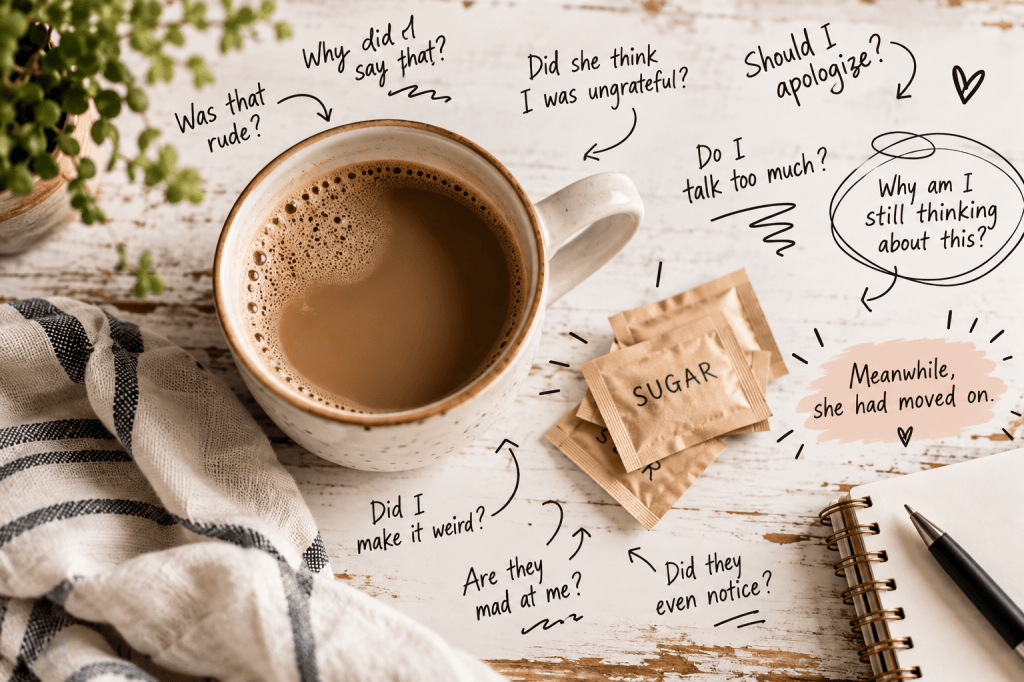
For me, that conversation continued for the next several months.
Because here’s the thing: I had put sugar in my coffee. Quite a bit of it, actually. At some point, her brain had filed away this tiny piece of information about me: Jessica takes sugar in her coffee.
Then she packed her family for a trip with thirteen children involved, remembered that tiny detail, and thought of me.
She brought me sugar.
Across state lines.
And what did I do with this thoughtful act of friendship?
“What?”
“Why?”
“Umm…no. I don’t.”
Wonderful, Jessica.
Just lovely.
Except, of course, that’s not really what happened.
I was caught off guard. I didn’t understand why she had brought me sugar because I wasn’t using it in my coffee anymore. My mouth answered the question before my brain had enough time to process the kindness behind it.
But my brain would eventually process it.
Again.
And again.
And again.
In the version my brain replayed, I wasn’t mildly confused. I was horrifically ungrateful.
She had lovingly carried sugar across state lines for me, and I had essentially slapped it out of her hand.
Every time I thought about it, I felt terrible.
I should have said thank you.
I should have told her how sweet it was that she remembered.
Why did I respond like that?
Did I hurt her feelings?
Did she think I didn’t appreciate her?
Did she think I was rude?
Months passed.
She was living her life.
I was apparently serving a self-imposed sentence for crimes against hospitality and granulated sugar.
Eventually, we were together for dinner, and I couldn’t take it anymore.
I needed to apologize.
And because I am nothing if not committed to making an insignificant social interaction significantly more significant, I didn’t just casually say, “Hey, by the way, I’ve always felt bad about that.”
No.
I approached this like I was about to confess something that might fundamentally alter our friendship.
“I really need to apologize to you for something I did that was very unkind.”
She looked confused.
Understandably.
But she let me continue.
So I told her the whole thing.
Branson.
The sugar.
The coffee.
My response.
How thoughtful she had been.
How rude I had sounded.
How badly I felt.
The months I had apparently spent emotionally processing a packet of sweetener.
She laughed.
“Oh my gosh. I literally haven’t thought about that one time since it happened.”
Excuse me?
Not once?
Because I had thought about it enough for both of us.
She told me it hadn’t seemed nearly as rude as I had convinced myself it was. It had been a tiny interaction. She had moved on almost immediately.
Meanwhile, I had produced, directed, edited, and repeatedly screened the extended cut.
And I wish I could tell you that was the moment I learned my lesson.
It was not.
Apparently I require continuing education.
Just the other day, a friend stopped me because I had apologized–again–for talking too much.
She pointed out that I had done this a few times.
Then she said something that stuck with me:
She didn’t know who had told me that lie, but I needed to stop telling it to myself.
I don’t talk too much.
Well.
That’s inconvenient.
Because I had already decided that I did.
Apparently, somewhere along the way, I developed the extraordinary ability to know exactly what other people are thinking about me without ever asking them.
It would be an incredible superpower if I were ever correct.
Instead, I do this thing where I supply the criticism myself.
Sorry, I’m talking too much.
Sorry, that was probably annoying.
Sorry, I know I’m over-explaining.
Sorry, I probably made that weird.
Sometimes nobody has actually accused me of any of those things.
I’ve simply decided what they’re probably thinking and apologized for it before they have the opportunity.
Which, when you really think about it, is a little presumptuous.
Apparently I am not only responsible for managing my own thoughts. I have appointed myself manager of yours, too.
You’re welcome.
My Brain Provides Postgame Coverage
I am an over-thinker.
I have ADHD. Rejection sensitivity and I are well acquainted. I also have a perfectionist streak that would very much like every interaction I have with another human being to be handled flawlessly.
So my brain doesn’t simply experience a social interaction.
It provides postgame coverage.
There are highlights.
Instant replay.
Slow motion.
Expert analysis.
Occasionally we bring in footage from three years ago for comparison.
Did you see her face when I said that?
Why did I word it like that?
Was that text too much?
Why did they just say “okay”?
Was that a normal okay or an “I am reevaluating everything I have ever thought about you” okay?
And God help us if someone responds with a thumbs-up.
Meanwhile, the other person is probably in the Chick-fil-A drive-thru trying to remember whether they ordered Polynesian sauce.
The strange thing is, I don’t extend this same level of scrutiny to everyone else.
Someone can stumble over their words while talking to me and I don’t spend the next six months thinking about it.
Someone tells a story that goes on a little too long and I don’t go home and announce to my family that Susan really lost control of the narrative tonight.
Someone wears an outfit I wouldn’t choose, sends a text with a typo, makes an awkward joke, forgets someone’s name, gets flustered, explains something badly, or has a weird moment.
And then I move on.
Because I have my own life to think about.
My own children.
My own deadlines.
My own insecurities.
My own weird things I said today.
My own sugar incident.
Which leads me to a realization that initially sounds a little insulting but is actually one of the most freeing things I’ve ever considered:
Nobody is thinking about me that much.
Not because nobody cares about me.
They do.
But because everyone else is busy being the main character inside their own head, too.
Maybe They Did Notice
I don’t think the answer is convincing myself that nobody ever notices when I’m awkward.
They probably do.
Maybe I really did talk too much.
Maybe somebody has misunderstood something I said.
Maybe someone has thought I was annoying.
Maybe somebody noticed the typo.
Maybe the joke didn’t land.
Maybe I walked away from an interaction thinking, that was weird, and the other person walked away thinking exactly the same thing.
Okay.
That’s different from assuming they’ve built a permanent wing in their memory dedicated to it.
Maybe they noticed.
And maybe I can survive being noticed imperfectly.
That might actually be the harder lesson for me.
Because perfectionism offers a pretty seductive deal:
If I can say everything correctly, explain myself thoroughly enough, anticipate every possible misunderstanding, make everybody comfortable, never talk too much, never say too little, never disappoint anyone, and never give another person a reason to think negatively about me…
then I can make sure nobody rejects me.
There is just one tiny problem.
That is completely impossible.
And exhausting.
And maybe that’s why the words in Proverbs hit a little differently when I read them through this lens:
“Fear of man will prove to be a snare, but whoever trusts in the Lord is kept safe.”
— Proverbs 29:25 (NIV)
A snare.
That’s exactly what it feels like.
Not necessarily some dramatic fear of people. Sometimes it’s just getting caught in the exhausting work of managing what I think everyone thinks about me.
Did they like me?
Did I say too much?
Did I offend them?
Did they misunderstand me?
Should I explain?
Should I apologize?
Should I send another text to clarify the first text, thereby creating an entirely new text for me to over-think?
It’s a trap because there is no finish line.
I can’t control every version of me that exists in somebody else’s head. I can’t explain myself into being universally understood. And I can’t apologize preemptively for every flaw someone might notice.
Maybe trusting God here looks less dramatic than I’ve sometimes imagined.
Maybe sometimes it looks like resisting the urge to chase down every possible misunderstanding. Letting someone have an opinion of me I can’t manage. Believing I can be imperfectly perceived and still be okay.
And trusting that when I actually do get it wrong, God has given me enough humility to apologize, enough grace to receive forgiveness, and enough wisdom to learn from it without sentencing myself to six months of replay.
Maybe the friend who told me I don’t talk too much is right.
Maybe I have been repeating things about myself that nobody actually asked me to believe.
The Good Part of Overthinking
Here’s the part I don’t want to lose, though.
I know why the sugar bothered me.
I loved my friend.
She had thought of me.
In the middle of packing her own family, she remembered something small about mine—how I took my coffee—and brought something specifically for me.
When I finally realized what she’d done, I wanted her to know that her kindness mattered.
That’s not something I want to get rid of.
I want to care when I hurt people.
I want to notice kindness.
I want to apologize when I’ve actually done something wrong.
I want the people I love to feel appreciated by me.
The problem wasn’t that I cared.
The problem was that my brain took a perfectly good instinct and put it on a hamster wheel for several months.
Maybe that’s the distinction I’m learning.
Caring about people doesn’t require constantly monitoring their imaginary opinions of me.
Self-awareness doesn’t require self-surveillance.
And being thoughtful doesn’t mean I need to conduct a forensic investigation every time a conversation feels slightly awkward.
Sometimes I can simply think:
Hmm. Wish I’d said that differently.
And then—
this is apparently an option—
move on.
No emergency meeting.
No three-month internal investigation.
No apology tour for an offense the alleged victim doesn’t remember occurring.
Just grace.
For them.
And, maybe more difficultly, for me.
Because somewhere out there is probably a person lying in bed replaying something awkward they said to me six months ago.
They are convinced I noticed.
They’re wondering if I thought it was weird.
They’re imagining what I must think of them now.
And I would love to reassure them:
I have absolutely no idea what you’re talking about.
I’ve been busy thinking about sugar.
Fiercely, Jessica


Leave a comment